Key Indicators of Violent Tendencies in At-Risk Students
This week is National Youth Violence Prevention Week. As an EdTech company that prioritizes student safety above all else, it got us thinking about how teachers, administrators, and the larger community can prioritize preventative measures amidst growing concerns over student safety—online and offline, at home and at school, and everywhere in between.
According to The Center for Homeland Defense and Security’s K-12 School Shooting Database, the number of school shootings and the amount of in-school violence have increased dramatically over the past five years. In September of 2021 alone, 153 school shooting threats were made. Half of the threats came from social media, while 28% of threats came from students who were in possession of or had access to firearms.
This puts school districts in a precarious position. While there are numerous national and state protocols that address how to handle student safety in public school districts, there is no one-size-fits-all playbook for addressing online threats. What this means for district leaders is that they need to take a proactive approach to protecting their schools.
Many districts have taken their own approach to student safety, going beyond federal and state regulation. These efforts might include:
-
Creating an effective incident response plan
-
Practicing safety drills
-
Using assemblies to communicate safety protocols
-
Working alongside parents to foster a collaborative approach to student safety
-
Providing sufficient numbers of well-trained on-site counselors and mediators
Ideally, your school shouldn’t have to be on the offensive side of a school threat, but implementing tactics like these is a good place to start. Preventative measures can mean the difference between having to deal with a violent incident and its aftermath and avoiding such incidents altogether.
Ignoring the signs could lead to liability
In the vast majority of cases, at-risk students who have violent tendencies show signs long before a threat is made, or acted upon. Understanding how to recognize these key behavioral indicators is crucial.
A tragic example of the importance of noticing key behavior trends, and responding appropriately, is the recent Oxford High School shooting. The shooter exhibited many key indicators prior to the incident that suggested he was struggling psychologically and needing help, and that he may end up taking extreme measures— unfortunately, the school officials’ response to those behavior flags wasn’t nearly as serious as it should have been.
In addition to the loss of life, injury, and trauma associated with this act of violence, the school is now facing three lawsuits seeking $100 million in damages each.
The Oxford High School shooting is just one example of many potentially preventable violent incidents. Moving forward, schools will undoubtedly be held accountable for safety shortcomings. Furthermore, school districts are becoming increasingly liable for lack of proper monitoring, preparedness, and risk incident responding.
"There is no concrete answer to the question, 'What will make a student commit a violent act?'," says Teodora Pavkovic, digital wellness expert and child psychologist. "But what school staff can do is pay attention to the signs that precede a violent incident. Taking a proactive, well-informed approach to potentially violent behavior can mitigate risks early on."
Train your staff to recognize the risks
Your staff is on the frontline. They have the best vantage point into the actions and minds of their students and are uniquely positioned to recognize risky behavior. However, it’s up to your district to prioritize training your staff on how to assess key indicators of violence and guide them on what to do next.
A research paper titled “Communication of Intent to Do Harm Preceding Mass Public Shootings in the United States, 1966 to 2019” found that school shooting threats were commonly associated with prior counseling and suicidal tendencies. These findings indicate that, for many students, their actions were preceded by calls for help.
Therefore, it’s crucial that you train your staff—and counselors in particular—to quickly recognize signs of extreme personal distress. Here are a few signs to look out for:
Social withdrawal
Social withdrawal is sometimes misinterpreted as being “quiet” or “shy.” When this happens suddenly, it in fact signals a change in the pattern of behavior for that student. Removing themselves from social situations may be an indicator of feeling depressed or unworthy, or of being bullied or harassed.
Excessive isolation
Children who don’t have many friends aren’t inherently violent; we often find that naturally introverted children, who prefer the company of only one or two friends, are frequently misunderstood and wrongly labeled as antisocial or just "weird."
However, students who never, or very rarely, interact with other students may be going through internal issues that are keeping them from forming bonds with their peers.
"Since we know that strong feelings of isolation and loneliness can be a trigger for violent behavior in both adults and children, this is something you and your staff should keep a close eye on," says Pavkovic.
Victims of violence
Students who have been victims of violence themselves tend to internalize those behaviors, and they often exhibit them in their interactions with their friends. Children who are victims of physical or sexual abuse are likely to develop violent tendencies directed both towards themselves and others.
Uncontrollable anger
Anger is a natural emotion that we all experience from time to time. But when students exhibit consistently angry, irritable, uncontrollable behaviors, especially in situations that don’t seem to warrant such reactions, there’s likely to be a deeper issue boiling under the surface.
Students who are bullied
No staff member should ignore bullying behavior under any circumstance. According to Pavkovic, "Bullying can affect students well beyond their K-12 years. Bullied students who don’t receive adequate support may vent their frustrations in violent ways and blame staff for the lack of care."
Therefore, it is important that your school and district have clear expectations from students when it comes to appropriate interpersonal communication, and that you and your staff intervene appropriately and consistently when these expectations aren’t met.
Expression of violence in schoolwork
Children tend to express their thoughts and feelings through art, poetry, games, and other kinds of creative work. An overrepresentation of violence, gore or anger in a student's work—particularly directed at family members, fellow students, schools, staff, etc—may be a sign of emotional struggles and a potential for violent acting out.
Use online student monitoring tools to flag risky behavior
Online monitoring takes a preventative approach to protecting student safety. The Internet has become integral to modern-day teaching, and today, teachers must take a hybrid approach to delivering the curriculum to their students.
With the mass introduction of remote learning—coupled with the skyrocketing growth of social media channels and gaming applications—recognizing potential violent behavior amongst children has become more complex.
"With so many students using the Internet to express themselves and communicate with others, monitoring behavior you can’t easily see becomes difficult," Pavkovic stated. "Faculty need to be able to recognize the ‘physical’ signs in the classroom, and the ‘digital’ signs based on students’ online activity."
The Iceberg metaphor below demonstrates the challenge inherent in protecting students, by recognizing both the signs above the water (physical) as well as those beneath the water (digital).
%20(6)%20(1).webp?width=920&height=552&name=Graphic%20%20Online%20%26%20Offline%20Risks%20%20US%20(2000%20%C3%97%201080px)%20(6)%20(1).webp)
Student online monitoring makes it possible to see below the surface, and address the symptoms and signs that aren’t immediately known to faculty.
Diving deeper with Linewize
Linewize Monitor tracks student input data to see how students are expressing themselves and communicating with each other online. When risky behavior is detected across several key categories, it gets flagged for further evaluation by the designated school officials at your district. When Linewize observes a high-risk student, a human moderator will call the school immediately.
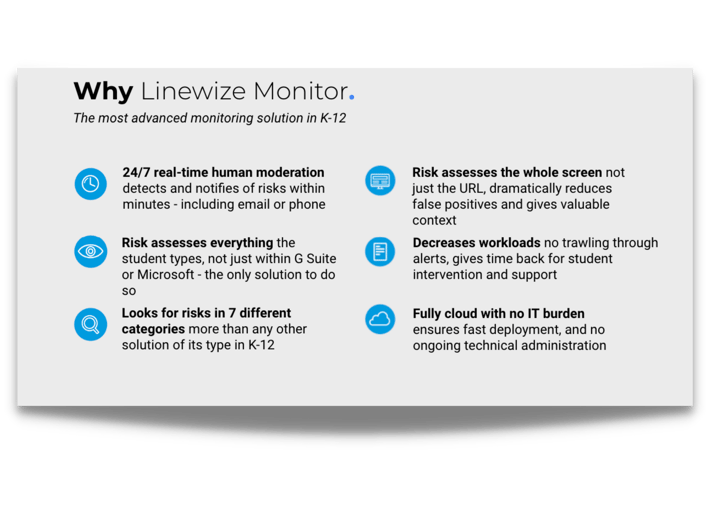
Most importantly, Linewize Monitor assesses contextual relevance. Using a combination of sophisticated AI and highly trained human moderators, each potentially suspicious piece of online activity is carefully routed through artificial intelligence first, and then analysts second. Human moderators examine red flags to ensure your district isn’t barraged with false positives, and only receives alerts to real potential risk.
If you’re interested in seeing how Linewize Monitor can help your district preserve and protect student safety, book a complimentary 30-day Student Safety Audit.
Over the course of 30 days, we’ll quickly deploy our solution and give you an evaluation of student safety at your district. Following the assessment, we’ll present you with visually-rich charts and graphs that illustrate our key findings.
Get a no-cost Student Safety Audit
Deploy Monitor for 30 days in your district to detect online threats to student safety and identify students who need additional support.

Tips for addressing key indicators of violent behavior
If you’ve flagged some of the aforementioned key indicators among certain students, it’s up to your team to mitigate those risks and utilize all available resources.
-
Set up regular meetings with your counseling team to better understand what’s happening in your school from a mental health and wellness perspective, as well as to stay on top of what your counselors’ need from you in order to be successful in their roles
-
Take extra steps to build a safe atmosphere for your student community when it comes to discussing mental health issues; help your students feel comfortable confiding in and expressing themselves to counseling staff
-
Incorporate Social Emotional Learning into your curriculum. Teaching children to fine-tune their empathy, take accountability for their actions, and communicate with others in respectful ways will help your students become better at identifying when their own emotions become problematic and need special attention, as well as when this happens to one of their peers
-
Ensure that your district-wide staff are up-to-date on any relevant laws and protocols that govern how staff are meant to intervene if they suspect imminent violent behavior, and make it a point to regularly check-in and make sure that they are at all times prepared to carry out such protocols
-
Staying on top of what your students are doing online has become as important as staying on top of their behavior inside classrooms and school halls. Have your more tech-savvy team members check-in with student’s behavior on any major social media and gaming platforms that they frequent.
Treat potentially violent students with compassion
Lastly, approach every potentially violent student with compassion. Numerous studies indicate that what shows up as bad behavior is often a masked cry for help; disciplining this kind of behavior with approaches like punishment or isolation can often exacerbate the situation. Take your time to talk to the student with a lot of patience and curiosity, without cornering, blaming, or scolding them.
Talk to us
Talk to an expert or book a demo. Our cyber safety experts are waiting to help.
Stay in touch
Sign up for our newsletter to get all the latest product information.